Say this, even if they have not asked
Say It Plainly, Then Ask
Pick a calm moment, side by side is fine: the car, the sofa, the edge of the bed. Put the name your child uses where Nan is, and swap the three "not because" examples for the worries that fit your child.
- "Can I tell you something really important about Nan dying?"
- "Some children worry that something they did made it happen. So I want to tell you, really clearly."
- "It did not happen because of anything you did. Not because you were noisy. Not because you did not want to visit. Not because of a cross thought you had once."
- "Thoughts cannot make somebody die. Words cannot make somebody die. Nothing you did, said or thought made it happen."
- "Have you been wondering about that?"
Then wait. A shrug is an answer. So is "no" said too quickly. Whatever they say, finish with: "You can ask me about it again, any time. I will always tell you the same thing."
That wording suits a child of about five to nine. A three year old needs one line: "You didn't do anything to make it happen." An older child needs the reasons behind it, and the space to argue with you.
If something your child did really was part of what happened, read the section on accidents further down before you use this script.
Those are the most important words on this page. The rest is why children do this, how to tell if yours has, and what to do when once is not enough.
Why Children Blame Themselves
It sounds strange to a grown-up. To a young child it makes perfect sense.
Young children often believe that thoughts and wishes can make things happen. Say a child was cross with Nan on Sunday and thought "I wish she'd go away". On Tuesday, Nan died. To a four year old, that is not a coincidence. That is cause and effect.
They also join together things that happened close together. A telling-off at tea, then a phone call, then everyone crying. A child can decide the telling-off caused it, and nobody will ever know, because they never say it.
Older children know perfectly well that thoughts do not kill anybody. Their guilt is quieter and more grown-up: the visit they skipped, the phone call they did not return, the time they were on their phone while Nan was talking. A nine year old can blame themselves for what they did not do, as easily as a four year old blames themselves for what they thought.
Why They Will Not Tell You
A child who believes they caused a death is carrying a secret that feels enormous. Saying it out loud feels dangerous. What if you agree? What if you are angry? What if saying it makes it more true?
Some children are also protecting you. They can see you are sad, and they do not want to add to it.
So do not wait to be asked. A child who never asks has not necessarily never wondered. Say it anyway, in the first few days, and again later. If they were not worried, you have lost nothing. If they were, you have lifted something they could not put down on their own.
What It Can Look Like
Most children will not say "I think it was my fault." Instead you might see:
- Very good, very quiet. A child who suddenly tidies their room, brings you tea and never mentions the person who died. It is loving, and it can also be a child trying to make up for something.
- Suddenly naughty. Some children push until they get told off. Being punished can feel like the right size for what they think they did.
- "What if" questions. "What if I had gone to see her?" "What if I had been nicer?" That is often the question underneath, asked sideways.
- Worry about you. If their thoughts can make someone die, then their cross thoughts about you are frightening too.
None of these prove anything on their own. Children grieve in all sorts of ways. But if you see them, it is one more reason to say the script above.
When They Said Something Cross
This one is common, and it can weigh on a child for years. "I hate you." "I wish you were dead." Said in a temper to a brother, a grandparent, even a pet, and then that person or that pet died.
Say it directly: "Everybody says cross things to people they love. I have. Saying it did not make it happen, and it does not mean you did not love them. They knew you loved them."
Do not brush past it with "Oh, you didn't mean it." They might have meant it, at the time. What matters is that words cannot make somebody die, and that love and crossness can live in the same person.
After A Pet, Or After Nan
When a pet is put down, say out loud whose fault it was not: "This is nobody's fault. Not yours, not mine, not the vet's." Children can blame themselves for not noticing the dog was poorly, or for the day they did not want to take her for a walk.
When a grandparent dies after a long illness, the guilt is usually about visiting. Say it before they do: "It was really hard to see Nan like that. Lots of people found it hard, grown-ups too. Not visiting did not make her ill, and visiting could not have stopped it. She knew you loved her."
Once Is Not Enough
You will say it, your child will nod, and three weeks later it will come back at bath time: "Was it because I was naughty?"
That does not mean you said it wrong. Children sometimes need to hear it many times, and they check an answer by asking for it again. Give the same answer, in the same words, every time: "No. Never. Nothing you did, said or thought made it happen." It is the same line as the script at the top, so your child hears one true sentence, over and over.
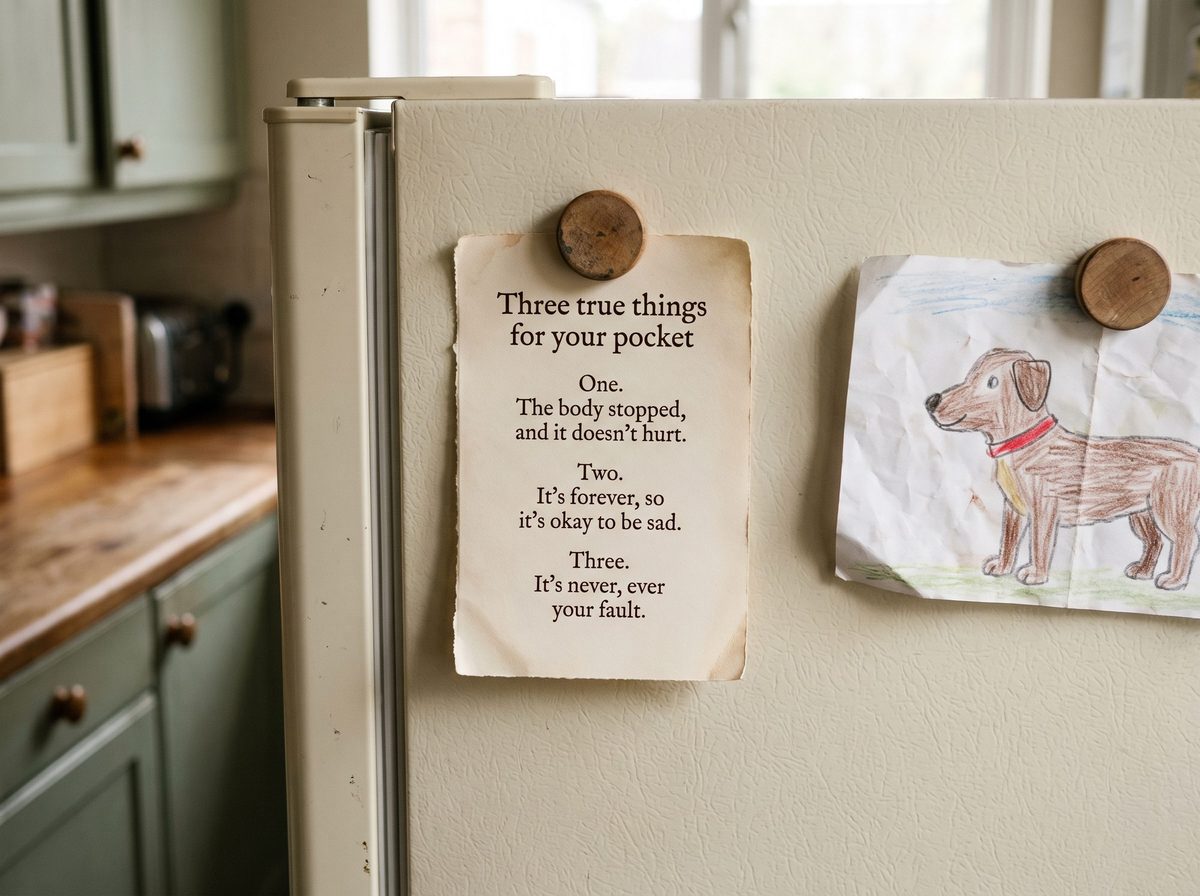
That is why it helps to have the words written down, and why a short line on the fridge can do some of the work for you.
Three Things To Leave Out
- "Don't be silly." It is meant as comfort. What a child hears is that the question was stupid, so they stop asking you. They do not stop wondering.
- "Just don't think about it." They cannot. Now they are thinking about it alone, and feeling bad for not being able to stop.
- "Be good for Mummy now." A child who already feels guilty hears a job they have to do to make up for it. Tell them instead that they can come and talk any time, and that it helps.
If you already said one of these, it is not too late. Go back tomorrow, when things are calm, and say the script at the top of this page. A better second answer is worth far more than a perfect first one.
If Something Your Child Did Was Part Of What Happened
Sometimes there is a real thread. A gate left open. A door not shut. A child who was there when something happened and could not stop it.
Then "it was nothing to do with you" will not ring true, and your child will know it. Tell them the truth in a different shape: "It was an accident. You did not want it to happen, and you did not mean it to happen. An accident is not the same as doing something bad."
This needs more than a page on a website. Please talk to your GP, and to Winston's Wish or Child Bereavement UK, early rather than late.
When To Get More Help
A lot of this is normal for a while: the same question asked again and again, clinginess, sudden worry that you will die, and bedtime getting harder.
Talk to your GP or your child's school if:
- they keep blaming themselves, even after you have told them, many times, that it was not their fault;
- the worry keeps getting bigger instead of slowly getting smaller;
- your child stops eating, sleeping or playing;
- they talk about wanting to die, or wanting to be with the person who died;
- or you are simply worried. That is reason enough.
Free support in the UK: Childline on 0800 1111, any time, for your child to ring themselves. Child Bereavement UK, Winston's Wish and Cruse Bereavement Support for families after a death. And if it was a pet, Blue Cross Pet Bereavement Support.
This page is one parent's words, written down. It is not counselling, and it does not replace counselling.
"It Is Never Your Fault", Written Into A Full Talk For Your Child's Age
The script at the top of this page is one piece of a bigger conversation. Each pack is the whole conversation for one kind of goodbye, written out word for word so you can read it in peace before you say it. Every pack says it inside the talks, and every pack ends with a fridge card whose third line is "It's never, ever your fault."
- What Happens When You Die (37 pages). For when your child asks what dying is, whether or not someone has died. Fifteen questions that come back, with answers, including "Is it my fault?"
- When A Pet Dies (26 pages). The Vet Week, before, during and after. Sudden deaths, the pet that never came home, and small pets.
- When A Grandparent Dies (43 pages). The long goodbye, hospital and hospice, what to do when they will not visit, dementia and the funeral.
- In every pack: three full talks, for ages 3 to 5, 6 to 8 and 9 to 12, burial and cremation in words a child can hold, a Words To Swap page, and when to get more help.
The words you change, like names, are marked in yellow. If it does not help, email me within 30 days and you get every penny back, no reason needed.
For more than one goodbye: the Complete Set is all three packs, plus eleven printable Memory Pages, for £29.99.
Not Buying Anything Today? Take The Free Card.
The Pocket Three Card is free for an email address. It gives you five lines to say when someone dies, including "It's not your fault. Nothing you did, or said, or thought made it happen", the soft phrases to swap for true ones, and three short lines printed big enough to stick on the fridge.
It downloads as soon as you enter your email on the home page, with a copy sent to you so you still have it next week.
Questions Parents Ask
Why does my child think the death was their fault?
Young children often believe thoughts and wishes can make things happen, and they link events that happened close together, like a telling-off and a death. Older children blame themselves for what they did not do, like a skipped visit. It is common, and it is rarely said out loud.
What do I say if my child thinks it was their fault?
Say it plainly: it did not happen because of anything you did, said or thought. Thoughts and words cannot make somebody die. Then ask if they have been wondering about it, and give the same answer every time it comes back.
Should I tell my child it was not their fault even if they have not asked?
Yes. Many children who blame themselves never say so. Saying it anyway costs nothing if they were not worried, and lifts a great deal if they were. If they keep blaming themselves after you have told them many times, talk to your GP or your child's school.
You cannot see inside your child's head. You do not need to. Say the true thing out loud, say it again next week, and let them hear it from you before they decide it for themselves.