If you already said one of them
Say Sorry First, Then Say The True Thing
Plenty of us have said one of these, in a panic, with about three seconds to think. It is not too late. Do it soon, somewhere calm. Put the name your child uses where Grandad is, and the words you actually said where he went to sleep is.
- "I need to tell you something, and I need to say sorry first."
- "When Grandad died, I told you he went to sleep. I said it because I was sad, and I did not want you to be sad too. But it was not the clearest way to say it."
- "The truth is, Grandad died. His body stopped working, and he cannot come back."
- "You might feel a bit cross with me. That is okay. You are allowed to be."
- "From now on, when something sad happens, I will tell you the real thing. Even when it is hard."
Then stop, and let them go next. They may have a question they have been saving up. They may just want a cuddle.
That wording suits a child of about six and up. For a three or four year old, keep it to two lines: "I said Grandad went to sleep. I'm sorry, that wasn't right. Grandad died, and he can't come back."
A better second answer is worth far more than a perfect first one. The rest of this page is the list: which phrases cause trouble, why, and what to say instead.
Why The Kindest Words Cause The Trouble
Grown-ups soften death because the plain word hurts to say. We know what "passed away" means, so the soft phrase does its job for us.
A young child does not have the grown-up meaning to fall back on. They hear exactly what you said, and they believe it. A soft phrase to you can be a puzzle, or a fear, to them. And because the phrase sounded so gentle, nobody thinks to check what the child made of it.
That is why the word "died" matters so much. It sounds hard to grown-up ears. To a child it is the only word that does not leave a door open.
The Ones That Leave A Door Open
These make a child think the person or pet might come back, or might be found.
- "She's gone to sleep." Sleep becomes the thing you do not wake up from, and bedtime can get much harder. Say instead: "She died. Sleeping is different. When you sleep, you always wake up."
- "We lost Grandad." Lost things get found. A small child may quietly wonder why nobody is out looking. Say instead: "Grandad died."
- "He's gone away." Away means coming back. They wait by the window. Say instead: "He died, and he can't come back."
- "She passed away." Too vague for a young child. Passed where? Say instead: "She died."
- "He's gone to live on a farm." Usually said about a pet. One day they find out, and then they wonder what else was not true. Say instead: "He died. I'll always tell you the real thing."
I learned the first one the hard way. My eldest was five when our dog died, and I told her he had gone to sleep. She would not go to bed that night, or most nights for a fortnight after. If bedtime has gone wrong in your house, here is what helped.
The Ones That Hand A Child A Grown-Up's Job
These are often said by kind relatives, at the funeral or on the doorstep. They sound like praise. What the child hears is a job.
- "Be brave for Mummy." It makes crying sound like failing, and it asks a child to look after a grown-up. Say instead: "You don't have to look after me. I'll look after you."
- "You're the man of the house now." A heavy weight for any child to carry, at any age. Say instead: "You're still a child, and you get to be looked after."
- "Don't upset your mum." It teaches a child to hide their sadness to protect the grown-ups. Say instead: "You can come and talk to your mum any time. It helps her."
You cannot stop every relative saying these. You do not need to correct them on the spot. Later, in the car, put it right gently: "Auntie said you have to be brave. You don't. You can feel however you feel, and I'll still be here."
The Ones That Close The Conversation
These are meant to comfort. What they tell a child is that this subject is finished, or that their feelings are the wrong size.
- "Don't cry." It teaches them to hide sad. Say instead: "It's okay to cry. I'm sad too."
- "At least she had a long life." True, and it can sound as if it should not hurt. Say instead: "She had a long life, and we still miss her so much."
- "You'll get over it." It makes love sound like something to finish. Say instead: "It will get softer. You'll always remember her."
- "I know exactly how you feel." They know you do not, quite. Say instead: "Tell me how it feels for you."
- "It was only a hamster." To a child it was not only anything. Say instead: "He was your hamster. Of course you miss him."
The Ones With A Hidden "Because"
These give a child a reason for the death. Children take reasons very seriously, and they apply them to themselves.
- "God needed another angel." Some children then worry about being chosen next, or feel angry with God. If faith matters in your family, share your belief, just without the "because".
- "He was ill, so he died." The next time your child gets a cold, they may panic. Say instead: "He was very, very ill, much more ill than a cold. The doctors couldn't make him better."
- "She's watching over you." Comforting for some children. Frightening for others, especially at bath time. If you are not sure, say: "Nobody knows for sure. You carry her love with you."
"She's A Star In The Sky Now"
If this is part of how your family comforts itself, you do not have to take it away. Young children can take it literally and go looking for her, so make sure the true thing sits underneath:
"You know how I said Nana is a star? That's a way some people like to remember someone who died. When we look at the stars, we think of her. But she isn't really up there. Nana died. Her body stopped working, and she can't come back. The star is for remembering her."
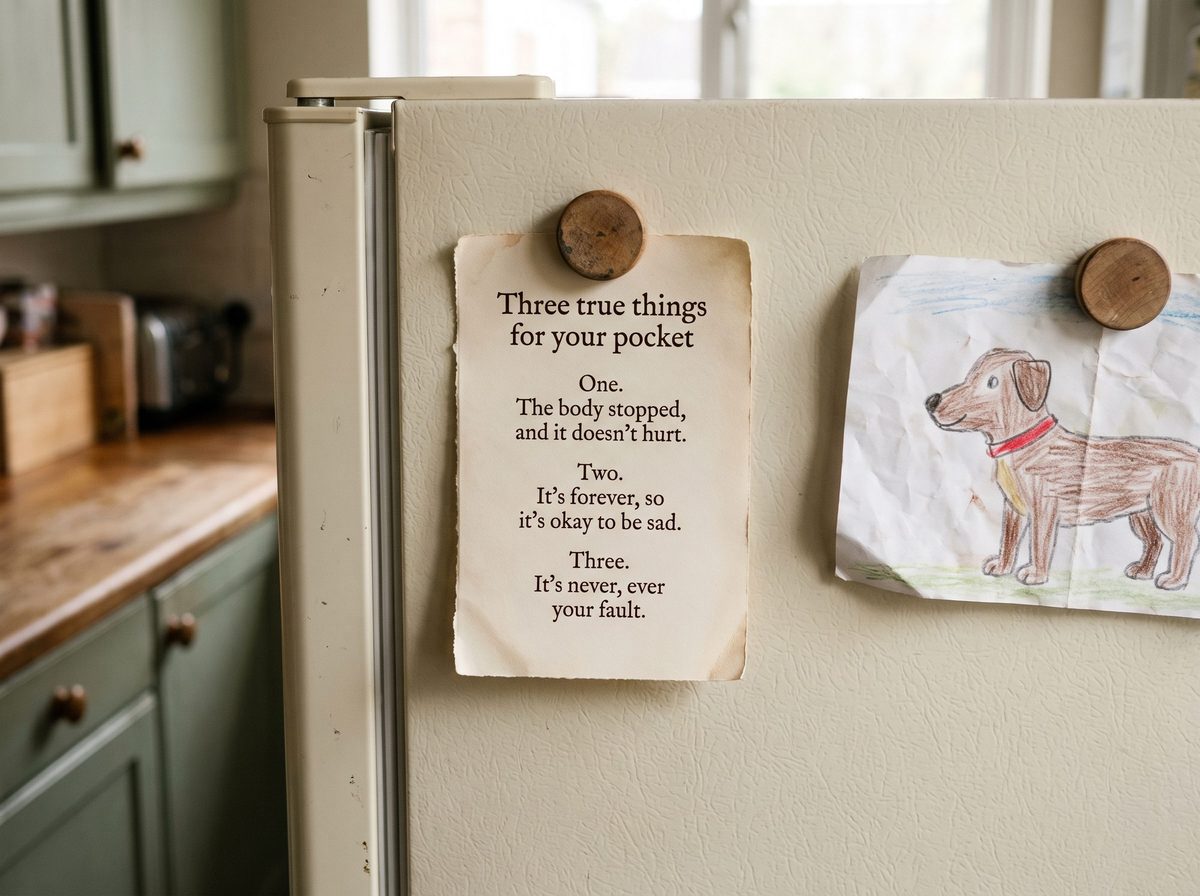
What To Say Instead: Three True Things
If you only remember one part of this page, remember this. Under almost every phrase above, there are three true things a grieving child needs to hear, in small words:
- The body stops, and it doesn't hurt. Not cold, not hungry, not scared.
- It's forever, so it's okay to be sad. They cannot come back, and sad is the right feeling for something that big.
- It's never, ever your fault. Nothing you did, said or thought made it happen. Children often wonder this quietly. Here is more on saying it, even if they have not asked.
Then one more, which is the best true thing of all: the body stops, and the love doesn't.
What Not To Do, As Well As Say
Some of the things that go wrong are not sentences at all.
- Hiding it. Children hear phone calls and whispers. When nobody explains, they fill the gap with something of their own, and it is often worse than the truth.
- Changing the subject every time. A child who is steered away twice learns not to ask a third time. They do not stop wondering. They just wonder alone.
- Swapping the pet. Buying a lookalike hamster or fish before your child notices is common, and kind in intent. If they find out later, they learn something you did not mean to teach.
- Deciding the funeral for them. A child should get a real choice about going, once they know what they would see. Keep the plan simple, and let them change their mind.
When To Get More Help
A lot of grief in children looks worrying and is normal: sadness that comes and goes, clinginess, the same question asked many times, worry that you will die, playing games about death or funerals, and bedtime getting harder for a while.
Talk to your GP or your child's school if:
- the sadness or worry keeps getting bigger instead of slowly getting smaller;
- your child stops eating, sleeping or playing;
- they keep blaming themselves, even after you have told them it is not their fault;
- they talk about wanting to die, or wanting to be with the person who died;
- or you are simply worried. That is reason enough.
Free support in the UK: Childline on 0800 1111, any time, for your child to ring themselves. Child Bereavement UK, Winston's Wish and Cruse Bereavement Support for families after a death. And if it was a pet, Blue Cross Pet Bereavement Support.
This page is one parent's words, written down. It is not counselling, and it does not replace counselling.
The True Words, Already Written, For The Goodbye In Front Of You
Knowing what not to say is half of it. The other half is having the right words ready when your child is looking at you. Each pack is the whole conversation for one kind of goodbye, written out word for word, so you can read it in peace before you say it out loud. Every pack has a Words To Swap page like the lists above, written for that goodbye.
- What Happens When You Die (37 pages). For when your child asks what dying is, whether or not someone has died. Includes a full section on putting it right if you already said the wrong thing, and "She's a star in the sky now".
- When A Pet Dies (26 pages). The Vet Week, the "put to sleep" problem, sudden deaths, small pets, and how to walk back "he's gone to a farm".
- When A Grandparent Dies (43 pages). The long goodbye, hospital and hospice, dementia and the funeral, with a note on what to do when kind relatives say the soft phrases.
- In every pack: three full talks, for ages 3 to 5, 6 to 8 and 9 to 12, burial and cremation in words a child can hold, a Words To Swap page, when to get more help, and a fridge card to print and cut out.
The words you change, like names, are marked in yellow. If it does not help, email me within 30 days and you get every penny back, no reason needed.
For more than one goodbye: the Complete Set is all three packs, plus eleven printable Memory Pages, for £29.99.
Not Buying Anything Today? Take The Free Card.
The Pocket Three Card is free for an email address. It gives you five lines to say when someone dies, four soft phrases like "gone to sleep", each with a true sentence to use instead, what to say if you already used one, and three short lines printed big enough to stick on the fridge.
It downloads as soon as you enter your email on the home page, with a copy sent to you so you still have it next week.
Questions Parents Ask
What should you not say to a grieving child?
Avoid soft phrases that leave a door open, like "gone to sleep", "lost" or "gone away", and phrases that hand a child a job, like "be brave for Mummy". Use the word "died", tell them it does not hurt, that it is forever so it is okay to be sad, and that it is never their fault.
Is it bad to say "passed away" to a child?
It is not cruel, but it is too vague for a young child, who may not know what "passed" means. "Died" is clearer and kinder in the long run. Older children usually understand "passed away", but "died" still does the job better.
I told my child their grandad went to sleep. Is it too late to fix it?
No. Go back soon, when things are calm. Say sorry first, then say the true thing: he died, his body stopped working, and he cannot come back. Add that sleeping is different, because when you sleep you always wake up. Let them be cross with you if they need to be.
You will still say the wrong thing sometimes. Everybody does. What your child will remember is not the slip. It is that you came back, said sorry, and told them the truth.