If you need to tell them now
Tell Them Soon, And Keep It Plain
Sit close, somewhere quiet. Put your pet's name where Biscuit is, and one plain sentence about what happened where the second line is.
- "Something very sad happened. Biscuit died."
- "He ran into the road, and a car hit him. His body was hurt too badly to keep working."
- "It was very quick. He can't hurt now. Not one bit."Only say "very quick" if it is true. If you do not know, leave that part out.
- "When something dies, it can't come back. That's why I'm so sad. You can be sad too."
- "It wasn't anybody's fault. Nobody wanted it to happen."
Then stop, and let them go next. A sudden death can make a child angry, very quiet or oddly cheerful. All of it is normal.
That wording suits a child of about five to eight. A three year old needs just the first line, the word "died", and a cuddle. A child of ten or eleven will want more of the facts, and deserves them.
That is the hardest sentence said. The rest of this page is for everything that comes with a sudden death: the body, the guilt, the small pet found in the morning, and the pet that simply never came home.
Why You Should Tell Them Soon
When there is no warning, it is tempting to wait until you have pulled yourself together, or until after school, or the weekend. Try not to wait long.
Children notice an empty basket, a quiet house and a grown-up who has been crying. If nobody explains, they fill the gap themselves, and what they come up with is often worse than the truth. You do not need to be calm to tell them. You can cry while you say it. It shows them that this is sad, and that you are still there.
Use the word "died". Not "we lost him", which makes a child wonder why nobody is out looking. Not "he's gone to sleep", which can make bedtime frightening. Plain words are the kind ones here.
If The Body Was Hurt
You do not need to show your child an injured pet, and you do not need to describe the injuries. Something like this is enough: "His body got hurt, so I've wrapped him in his blanket. You can stroke the blanket if you want."
That lets them say goodbye with their hands, which matters to a lot of children, without seeing something they cannot unsee. If they ask what he looked like, keep it simple and true: "He was hurt, and he was very still."
If Your Child Thinks It Was Their Fault
With a sudden death, there is sometimes a real thread. A gate left open. A door not shut. A child who was holding the lead. If there is, your child will already be thinking about it. Say it before they have to ask:
"Leaving the gate open was a mistake. Everybody makes mistakes. Grown-ups too. Biscuit dying was an accident. Nobody wanted it to happen. You are not in trouble, and I love you exactly the same as I did this morning."
Even when there is no thread at all, children can quietly decide it was their fault: the walk they did not want to go on, the day they were cross with him. Say it anyway: "It wasn't because of anything you did, or said, or thought." There is more on children blaming themselves here, including what to do if the guilt keeps coming back.
If It Happened At The Vet
Sometimes the sudden part is the phone call. The vet has found something, and the kindest thing is to help your pet die today, before your child can get there.
Tell them plainly afterwards: "Biscuit was very, very poorly, much more poorly than we knew. The vet couldn't make him better, and he was hurting. So the vet helped him die peacefully. It didn't hurt him, and it wasn't anybody's fault." Avoid "put to sleep", even though the vet may say it. If you had a day or two's warning, this page on telling a child before the vet is the one you need.
Hamsters, Fish And Guinea Pigs
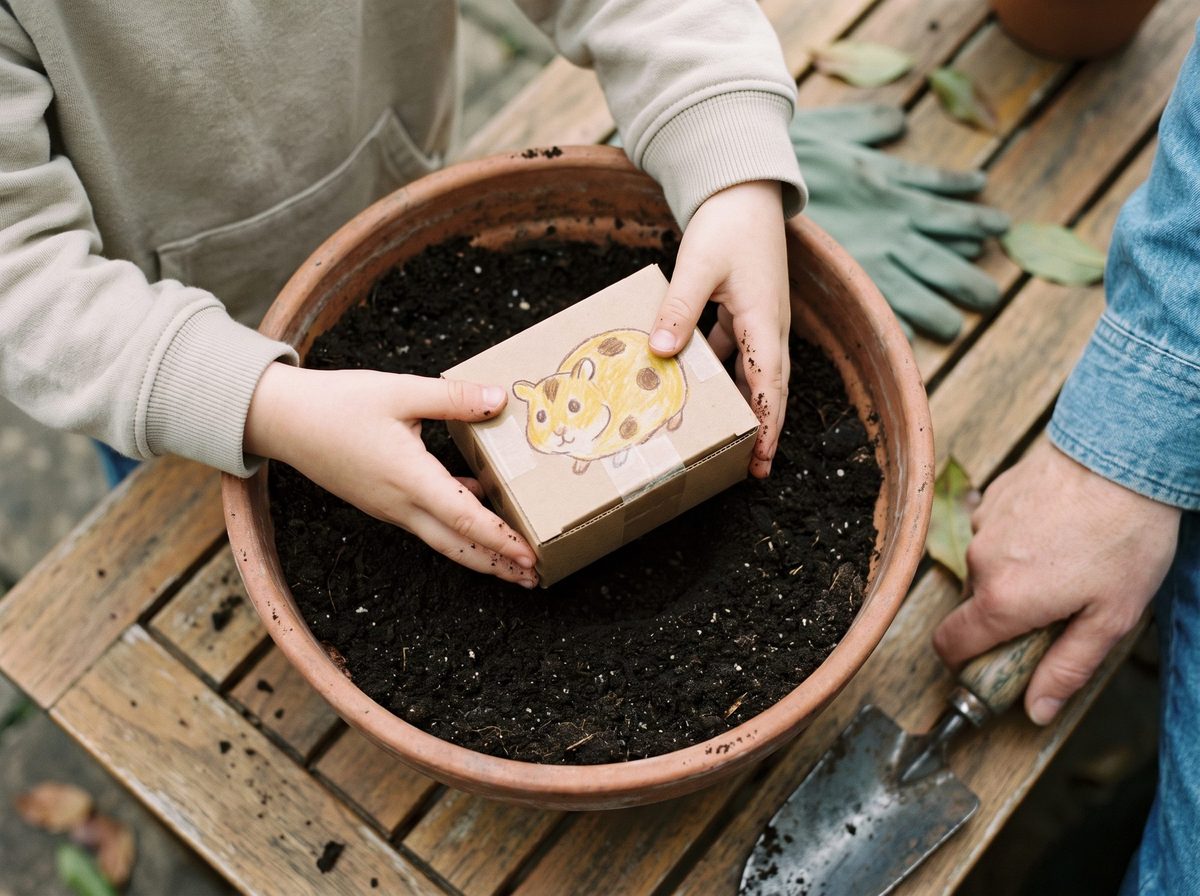
A small pet is often a child's first death, and it often comes with no warning at all. A very small animal can leave a very big hole. Take it as seriously as your child does.
If you find them first, check before your child sees, if you can. Then tell them, and let them choose whether to see him. A small pet that has died usually just looks very still. You can say: "Hamsters have much shorter lives than people. Two years is old for a hamster. Crumble lived a whole hamster life, and you gave him a really good one." Only use the "whole life" line if it is true. If a young pet died, say that nobody knows exactly why, and that it was not because of anything your child did.
Please do not flush the fish. It is quick and practical, and I very nearly did it myself. My youngest was four, still in pyjamas on a school morning, nose against the tank: "Why isn't Bubbles swimming?" I already had Bubbles in a piece of kitchen roll and my hand on the flush handle. Then I stopped. We buried Bubbles in a yoghurt pot under the rosemary, and my four-year-old said, "Bye, Bubbles. You were a good fish." Wrap the fish in a tissue or put it in a small box, and bury it in the garden or a plant pot, with your child there. It takes five minutes, and it tells your child that small lives matter too.
Please do not buy a lookalike. Swapping a dead hamster or fish for a new one before your child notices is very common, and kind in intent. But this is a safe, small place to learn that sad things can be survived. If they find out later, they learn something else instead.
If They Went Missing And Never Came Back
This is its own kind of sudden. There is no body, no goodbye and no certain answer, and children can keep hoping for a very long time.
Do not say the pet died if you do not know. Do not promise they will come home. Say what you know, and what you don't: "We've looked everywhere. I have to be honest with you. I don't know what happened to Tiger. Nobody does. But I don't think he's coming home now. It's okay to still hope a little bit, and it's okay to be sad. You can feel both at the same time."
Then choose a day to stop searching, and tell your child when it is. A small goodbye, like putting the food bowl away together, gives everyone a place to stop. And if he does turn up one day? Celebrate. You never lied. You said you didn't know.
Three Phrases To Leave Out
- "It was only a hamster." To your child it was not only anything. Try: "He was your hamster. Of course you miss him."
- "We'll get another one." Maybe one day. Said now, it tells a child the pet they loved could be swapped.
- "He's gone to live on a farm." One day they find out, and then they wonder what else you told them that was not true.
If you already said one of these, it is not too late. Say sorry first, then the true thing: "I told you Biscuit went to live on a farm. That wasn't true. I'm sorry. Biscuit died." Let them be cross with you if they need to be.
Tell The School
One short message to the teacher or nursery is enough. Say that your pet died suddenly, that your child is upset, and that you are using the word "died" at home. A teacher who knows can give a quiet word instead of a telling-off for not concentrating.
When To Get More Help
Sadness that comes and goes, clinginess, the same questions asked again and again, worry that you or another pet will die, and bedtime getting harder are all normal after a pet dies. A sudden death can hit harder, because there was no goodbye.
Talk to your GP or your child's school if:
- the sadness or worry keeps getting bigger instead of slowly getting smaller;
- your child stops eating, sleeping or playing;
- they saw the accident, and it keeps coming back to them in nightmares or play;
- they talk about wanting to die, or wanting to be with the pet;
- the death has stirred up a bigger loss, such as a person who died before;
- or you are simply worried. That is reason enough.
Free support in the UK: Blue Cross Pet Bereavement Support, free and confidential, and there for grown-ups too. Childline on 0800 1111, any time, for your child to ring themselves. And if a person has died too, Child Bereavement UK, Winston's Wish and Cruse Bereavement Support.
This page is one parent's words, written down. It is not counselling, and it does not replace counselling.
Every Word For A Pet's Goodbye, Sudden Or Not, Written Out For Your Child's Age
The script at the top of this page is one version, for one age. When A Pet Dies is the whole thing, written out word for word so you can read it in peace tonight, before the questions start:
- If it was sudden: the accident, the illness overnight, and what to say if your child left the gate open.
- If they went missing and never came back.
- Hamsters, fish and guinea pigs: finding them in the morning, why you never flush it, and never buying a lookalike.
- Three full talks, for ages 3 to 5, 6 to 8 and 9 to 12. Three different talks, not one cut shorter.
- The Vet Week, for when there is time to prepare, and the "put to sleep" problem with the two sentences that fix it.
- The questions that come back, like "Can we dig him up?" and "Can we get a new puppy?", with answers.
- A ready-to-send message for school, burial and cremation in words a child can hold, a Words To Swap page, what to do if you already said the wrong thing, and a fridge card to print and cut out.
The words you change, like your pet's name, are marked in yellow. If it does not help, email me within 30 days and you get every penny back, no reason needed.
For more than one goodbye: the Complete Set is all three packs, for a pet, a grandparent and the question out of nowhere, plus eleven printable Memory Pages, for £29.99.
Not Buying Anything Today? Take The Free Card.
The Pocket Three Card is free for an email address. It gives you five lines to say when it happens, the soft phrases like "gone to sleep" with a true sentence to use instead, what to say if you already used one, and three short lines printed big enough to stick on the fridge.
It downloads as soon as you enter your email on the home page, with a copy sent to you so you still have it next week.
Questions Parents Ask
How do I tell my child our pet died suddenly?
Tell them soon, somewhere quiet, and use the word "died". Give one plain sentence about what happened, tell them it cannot hurt now, that it cannot come back, and that it was nobody's fault. Then stop and let them react. You can cry while you say it.
Should my child see the pet's body after an accident?
Not if the body was badly hurt. You can wrap the pet in a blanket and let your child stroke the blanket to say goodbye. If the body is not hurt, let your child choose whether to see it, and tell them first that it will look very still.
Should I replace my child's hamster or fish before they notice?
It is kind in intent, but it is better not to. A small pet is often a child's first death, and a safe place to learn that sad things can be survived. Tell them the pet died, and bury it together in the garden or a plant pot. Please do not flush a fish.
There was no time to prepare, and you will not say it perfectly. You do not need to. Your child needs the true thing, in plain words, from someone who stays close while they take it in.